
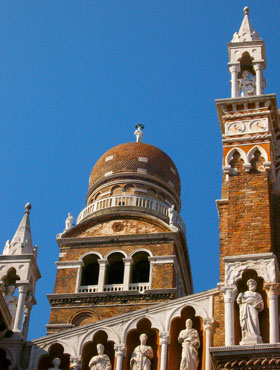
Unique to the Venetian Gothic architectural style is the desire for lightness and grace in structure. While other European cities often favored heavy buildings, Venice had always held the concern that every inch of land is valuable, because of the canals running through the city. Therefore, the Venetian Gothic, while far more intricate in style and design that previous construction types in Venice, never allowed more weight or size than necessary to support the building. This is an interesting concept because, while the window traceries in Northern Gothic construction only supported stained glass, the traceries in Venetian Gothic supported the weight of the entire building. Therefore the immense weight sustained by the traceries only alludes to the extreme weightlessness of the buildings as a whole.
One major aspect of the Venetian Gothic style change that came about during the 14th and 15th centuries was the proportion of the central hall in secular buildings. This hall, known as the portego, evolved into a long passageway that was often opened by a loggia with gothic arches. Architects favored using intricate traceries, similar to those found on the Doge’s Palace.
The most iconic Venetian Gothic structure, the Doge’s Palace, is a luxuriously decorated building that includes traits of Gothic, Moorish, and Renaissance architectural styles. In the 14th Century, following two fires that destroyed the previous structure, the palace was rebuilt in its present, recognizably Gothic form.
abc
abc