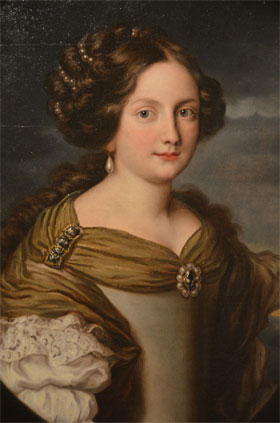
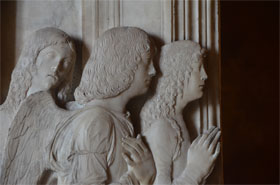
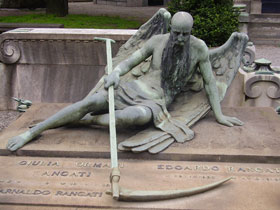
The Pinacoteca di Brera is one of Milan’s most important art galleries. It contains one of the foremost collections of Italian paintings, an outgrowth of the cultural program of the Brera Academy, which shares the site in the Brera Academy. It contains masterpieces such as the Brera Madonna by Piero della Francesca. The Castello Sforzesco hosts numerous art collections and exhibitions. The best known of the current civic museums is the Pinacoteca del Castello Sforzesco, with an art collection including Michelangelo’s last sculpture, the Rondanini Pietà, Andrea Mantegna’s Trivulzio Madonna and Leonardo da Vinci’s Codex Trivulzianus manuscript. The Castello complex also includes The Museum of Ancient Art, The Furniture Museum, The Museum of Musical Instruments and the Applied Arts Collection, The Egyptian and Prehistoric sections of the Archaeological Museum and the Achille Bertarelli Print Collection.
Milan’s figurative art flourished in the Middle-Ages, and with the Visconti family being major patrons of the arts, the city became an important centre of Gothic art and architecture (Milan Cathedral being the city’s most formidable work of Gothic architecture). Also, rule of the Sforza family, between the 14th and 15th century, was another period in which art and architecture flourished. Milan became the seat of an elegant Renaissance court, while great works, such as the Ospedale Maggiore, the public hospital designed by Filarete were built, and artists of the calibre of Leonardo da Vinci came to work in Milan, leaving works of inestimable value, such as the fresco of the Last Supper and the Codex Atlanticus.
abc
Bramante also came to Milan to work on the construction of some of the most beautiful churches in the city; in Santa Maria delle Grazie the beautiful luminous tribune is by Bramante, as is the church of Santa Maria presso San Satiro.
The city was affected by the Baroque in the 17th and 18th centuries, and hosted numerous formidable artists, architects and painters of that period, such as Caravaggio and Francesco Hayez, which several important works are hosted in Brera Academy.
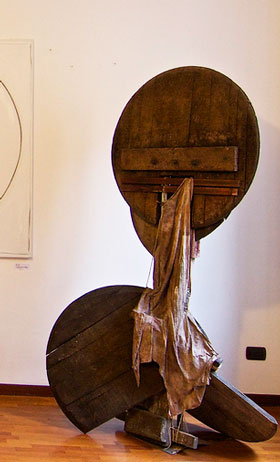
Milan in the 20th century was the epicenter of the Futurist artistic movement. Filippo Marinetti, the founder of Italian Futurism wrote in his 1909 “Futurist Manifesto” (in Italian, Manifesto Futuristico), that Milan was “grande…tradizionale e futurista” (“grand…traditional and futuristic“, in English). Umberto Boccioni was also an important Futurism artist who worked in the city. Today, Milan remains a major international hub of modern and contemporary art, with numerous modern exhibitions. The Museum of Twentieth Century, sited in the Arengario palace near Duomo square in the centre of Milan, is one of the most important art galleries about Italian and international Twentieth Century’s art in Italy: of particular relevance are the sections dedicated to Futurism, Spatialism and Arte povera.
abc
The Museo Poldi Pezzoli is another of the city’s most important and prestigious museums. The museum was originated in the 19th century as the private collection of Gian Giacomo Poldi Pezzoli and his mother, Rosa Trivulzio, of the family of the condottiero Gian Giacomo Trivulzio, and has a particularly broad collection of Northern Italian and (for Italy) Netherlandish/Flemish artists. The Museum of the Risorgimento (Museo del Risorgimento) is a museum in Milan on the history of Italian unification from 1796 (Napoleon’s first Italian campaign) and 1870 (Rome’s annexation into the Kingdom of Italy) and on Milan’s part in it (particularly the Five Days of Milan). It is housed in the 18th century Palazzo Moriggia. Its collections include Baldassare Verazzi’s Episode from the Five Days and Francesco Hayez’s 1840 Portrait of Emperor Ferdinand I of Austria. La Triennale di Milano is a design museum and events venue located inside the Palace of Art building, part of Parco Sempione, the park grounds adjacent to Castello Sforzesco. It hosts exhibitions and events highlighting contemporary Italian design, urban planning, architecture, music, and media arts, emphasizing the relationship between art and industry.
abc