
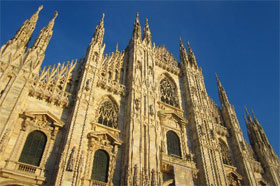
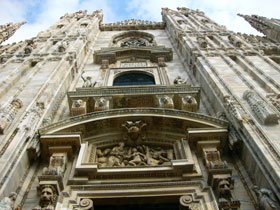
There are few remains of the ancient Roman colony that later became a capital of the Western Roman Empire. During the second half of the fourth century, Saint Ambrose, as bishop of Milan, had a strong influence on the layout of the city, redesigning the centre (although the cathedral and baptistery built at this time are now lost) and building the great basilicas at the city gates: Sant’Ambrogio, San Nazaro in Brolo, San Simpliciano and Sant’Eustorgio, which still stand, refurbished over the centuries, as some of the finest and most important churches in Milan. The largest and most important example of Gothic architecture in Italy, Milan’s Cathedral, is the fourth largest in the world after St. Peter’s Basilica in Rome, the Cathedral of Seville and a new cathedral in Côte d’Ivoire. Built between 1386 and 1577, it hosts the world’s largest collection of marble statues and has a widely visible golden Madonna statue on top of the spire, nicknamed by the people of Milan as Madunina (the little Madonna), that became one of the symbols of the city.
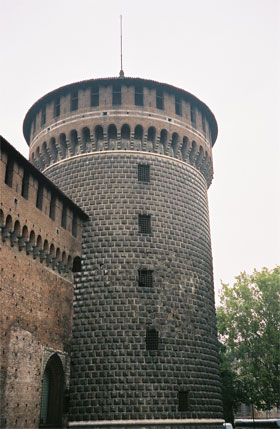
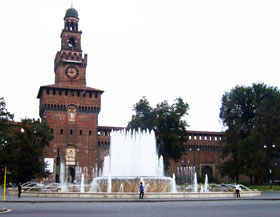
In the second half of the fifteenth century, when the Sforza ruled the city, the old Visconti fortress was enlarged and embellished to became the Castello Sforzesco: the seat of an elegant Renaissance court surrounded by a walled hunting park stocked with game captured around the Seprio and Lake Como. Notable architects involved in the project included the Florentine Filarete, who was commissioned to build the high central entrance tower, and the military specialist Bartolomeo Gadio. The political alliance between Francesco Sforza and the Florence of Cosimo de’ Medici bore architectural fruit, as Milanese building came under the influence of Brunelleschian models of Renaissance architecture. The first notable buildings to show this Tuscan influence were a palazzo built to house the Medici Bank (of which only the main entrance survives) and the centrally planned Portinari Chapel, attached to Sant’Eustorgio and built for the first manager of the bank’s Milan branch. Filarete, while in Milan, was responsible for the great public hospital known as the Ospedale Maggiore, and also for an influential Treatise on Architecture, which included a plan for a star-shaped ideal city called Sforzinda in honour of Francesco Sforza and passionately argued for the centrally planned form.
abc
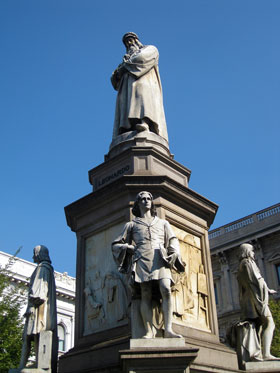
Leonardo da Vinci, who was in Milan from around 1482 until the fall of the city to the French in 1499, was commissioned in 1487 to design a tiburio, or crossing tower for the cathedral, although he was not chosen to build it. However, the enthusiasm he shared with Filarete for the centrally-planned building gave rise in this period to numerous architectural drawings, which were influential in the work of Donato Bramante and others. Bramante’s work in the city, which included Santa Maria presso San Satiro (a reconstruction of a small 9th-century church), the beautiful luminous tribune of Santa Maria delle Grazie and three cloisters for Sant’Ambrogio, drew also on his studies of the Early Christian architecture of Milan such as the Basilica of San Lorenzo.
The Counter-Reformation was also the period of Spanish domination and was marked by two powerful figures: Saint Charles Borromeo and his cousin, Cardinal Federico Borromeo. Not only did they impose themselves as moral guides to the people of Milan, but they also gave a great impulse to culture, with the creation of the Biblioteca Ambrosiana, in a building designed by Francesco Maria Ricchino, and the nearby Pinacoteca Ambrosiana. Many notable churches and Baroque mansions were built in the city during this period by the architects, Pellegrino Tibaldi, Galeazzo Alessi and Ricchino himself.
Empress Maria Theresa of Austria was responsible for the significant renovations carried out in Milan during the 18th century. She instigated profound social and civil reforms, as well as the construction of many of the buildings that still today constitute the pride of the city, like the Teatro alla Scala, inaugurated on 3 August 1778 and today one of the world’s most famous opera houses. The annexed Museo Teatrale alla Scala contains a collection of paintings, drafts, statues, costumes, and other documents regarding opera and La Scala’s history. La Scala also hosts the Ballet School of the Teatro alla Scalla. The Austrian sovereign also promoted culture in Milan through projects such as converting the ancient Jesuit College, in the district of Brera, into a scientific and cultural centre with a Library, an astronomic observatory and the botantical gardens, in which the Art Gallery and the Academy of Fine Arts are today placed side by side. Milan was also widely affected by the Neoclassical movement in the late 18th and early 19th centuries, transforming its architectural style.
abc
French Imperial rule of the city in the early 19th century produced several fine Neoclassical structures and mansions, Many of these are located in the Corso Venezia district, including Villa Reale or Villa del Belgiojoso, built by Leopoldo Pollack in 1790. It housed the Bonaparte family, mainly Josephine Bonaparte, but also several others key political figures of 1800, such as Count Joseph Radetzky von Radetz and Eugene de Beauharnais. It is often regarded as one of the best types of Neoclassical architecture in Milan and Lombardy, surrounded by an English landscape garden. Today, it hosts a Gallery Contemporary Art in a fine context of classical columns, vast halls, marble statues and crystal chandeliers.
Additionally, major examples of Neoclassical architecture in the city include Palazzo Belgiojoso, former grand Napoleonic residence, and Palazzo Tarsis, built by Luigi Clerichetti for Count Paolo Tarsis in 1834, famous for its ornate façade. The massive Arch of Peace, also known as Porta Sempione (Sempione Gate), is situated in Piazza Sempione right at the end of the homonymous park. It is often compared to a miniature version of the Arc de Triomphe in Paris. The works began in 1806 by order of Napoleone Bonaparte, under superivision of architect Luigi Cagnola. Just like with the Arc de Triomphe, Napoleon’s 1815 defeat at the Battle of Waterloo, halted the construction of the monumental arch, but Emperor Franz Josef I of Austria ordered it to be completed as a celebration of the Vienna Congress and the peace treaties of 1815. It was completed by Francesco Peverelli on 10 September 1838. Another noted Neoclassical building in the city is the Palazzo del Governo, constructed in 1817 by Piero Gilardoni.
abc
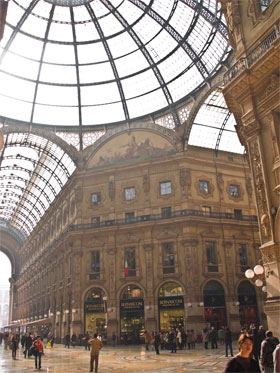
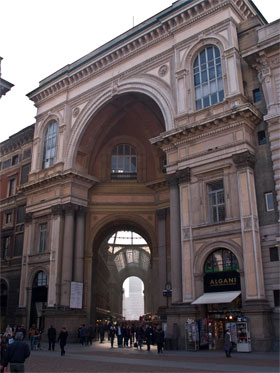
In the second half of the 19th century, Milan quickly became the main industrial center in Italy, drawing inspiration from the great European capitals that were hubs of the technological innovations of the second industrial revolution and, consequently, of the deep social change that had been put in motion. The great Galleria Vittorio Emanuele II, a covered passage that connects Piazza del Duomo, Milan to the square opposite of La Scala opera house, was built by architect Giuseppe Mengoni between 1865 and 1877 to celebrate Vittorio Emanuele II, first king of reunited Italy. The galleria is covered by an arching glass and cast iron roof, a popular design for 19th-century arcades, such as the Burlington Arcade in London, which was the prototype for larger glazed shopping arcades, beginning with the Saint-Hubert Gallery in Brussels and the Passazh in St Petersburg. Another late 19th century eclectic monument in the city is Cimitero Monumentale, built in a Neo-Romanesque style by several architects between 1863 and 1866.
The tumultuous period of early 20th century brought several, radical innovations in Milanese architecture. Art Nouveau, also known as Liberty in Italy, started to develop in the city during the years before the Great War; alongside other major Italian cities, most notably Palermo and Turin, this particular style became highly popular, producing several notable buildings in the city,developing its own, individual style known as “Liberty Milanese” (Milanese Art Nouveau), which, in many aspects, shares many traits with Vienna Secession. Possibly one of the most notable Art Nouveau edfices in Milan is Palazzo Castiglioni in Corso Venezia, built by architect Giuseppe Sommarugo between 1901 and 1904. Other remarkable examples include Hotel Corso and Berri-Meregalli house, the latter built in a traditional Milanese Art Nouveau style combined with elements of neo-Romanesque and Gothic revival architecture, regarded as one of the last such types of architecture in the city. In 1906, with the Universal Exposition, the city was able to exhibit its Art Nouveau works, that was thus considered the official style of the exposition.
abc
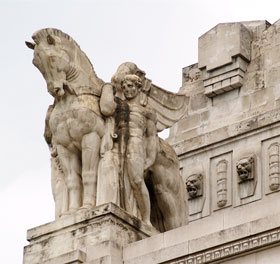
Nonetheless, as the century progressed, other styles started to be explored, including neo-Romanesque, eclectic and Gothic revival architecture, so Art Nouveau started falling out of fashion by c. 1913, when the official season was closed by Sommaruga. A new, more eclectic form of architecture can be seen in buildings such as Castello Cova, built the 1910s in a distinctly neo-medioeval style, evoking the architectural trends of the past. A late Example of Art Deco, which blended such styles with Fascist architecture, is the massive Milano Centrale railway station by Ulisse Stacchini, inaugurated in 1931.
The post–World War II period saw rapid reconstruction and fast economic growth, accompanied by a nearly twofold increase in population. A strong demand for new residential and commercial areas drove to extreme urban expansion and architectural renewal, that has produced some of the major milestones in the city’s architectural history, including Gio Ponti’s Pirelli Tower (1956–60), Velasca Tower (1956–58), and the creation of brand new residential satellite towns, as well as huge amounts of low quality public housings.
In recent years, de-industrialization, urban decay and gentrification led to a massive urban renewal of former industrial areas, that have been transformed into modern residential and financial districts, notably Porta Nuova and FieraMilano in the suburb of Rho. The old Fiera area is being completely rebuilt thanks to the project Citylife and will feature, amongst residences, museums and a large park, three skyscraper designed by famous international architects, from whom they will take the names: Isozaki Tower, Hadid Tower and Libeskind Tower. They will all have remarkable shapes: the Hadid Tower is twisted, the Libeskind Tower and the Isozaki Tower, although being perfectly straight, will reach 200m becoming the tallest building in Italy.
abc
abc