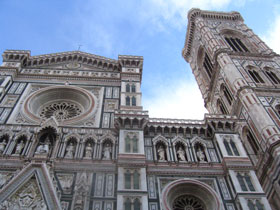
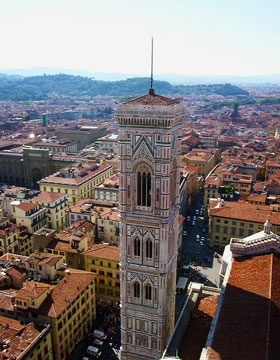
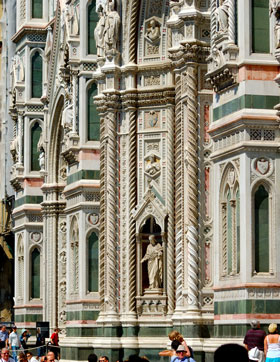
Florence is known as the “cradle of the Renaissance” (la culla del Rinascimento) for its monuments, churches and buildings. Florentine architects such as Filippo Brunelleschi (1377–1466) and Leon Battista Alberti (1404–1472) were among the fathers of both Renaissance and Neoclassical architecture. The best-known site of Florence is the domed cathedral of the city, Santa Maria del Fiore, known as The Duomo, whose dome was built by Filippo Brunelleschi. The nearby Campanile (partly designed by Giotto) and the Baptistery buildings are also highlights. The dome, 600 years after its completion, is still the largest dome built in brick and mortar in the world. The centre of the city is contained in medieval walls that were built in the 14th century to defend the city.
The layout and structure of Florence in many ways harkens back to the Roman era, where it was designed as a garrison settlement. Nevertheless, the majority of the city was built during the Renaissance. Despite the strong presence of Renaissance architecture within the city, traces of medieval, Baroque, Neoclassical and modern architecture can be found. ThePalazzo Vecchio as well as the Duomo, or the city’s Cathedral, are the two buildings which dominate Florence’s skyline.
The River Arno, which cuts through the old part of the city, is as much a character in Florentine history as many of the people who lived there. Historically, the locals have had a love-hate relationship with the Arno – which alternated between nourishing the city with commerce, and destroying it by flood.
One of the bridges in particular stands out – the Ponte Vecchio (Old Bridge), whose most striking feature is the multitude of shops built upon its edges, held up by stilts. The bridge also carries Vasari’s elevated corridor linking the Uffizi to the Medici residence (Palazzo Pitti). Although the original bridge was constructed by the Etruscans, the current bridge was rebuilt in the 14th century. It is the only bridge in the city to have survived World War II intact. It is the first example in the western world of a bridge built using segmental arches, that is, arches less than a semicircle, to reduce both span-to-rise ratio and the numbers of pillars to allow lesser encumbrance in the riverbed (being in this much more successful than the Roman Alconétar Bridge)
The church of San Lorenzo contains the Medici Chapel, the mausoleum of the Medici family—the most powerful family in Florence from the 15th to the 18th century. Nearby is the Uffizi Gallery, one of the finest art museums in the world – founded on a large bequest from the last member of the Medici family.
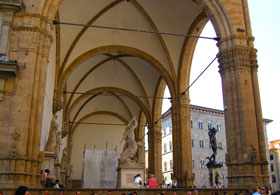
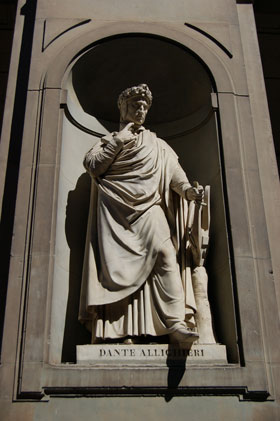
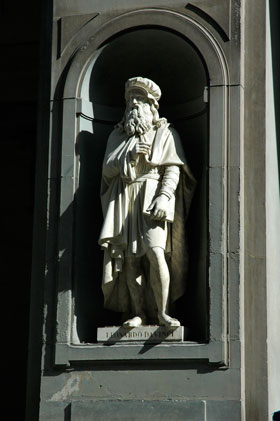
The Uffizi is located at the corner of Piazza della Signoria, a site important for being the centre of Florence’s civil life and government for centuries. The Palazzo della Signoria facing it is still home of the municipal government. The Loggia dei Lanzi provided the setting for all the public ceremonies of the republican government. Many significant episodes in the history of art and political changes were staged here.
The Piazza della Signoria is the location of a number of statues by other sculptors such as Donatello, Giambologna, Ammannati and Cellini, although some have been replaced with copies to preserve the originals.
Monuments
Florence contains several palaces and buildings from various eras. The Palazzo Vecchio is the town hall of Florence and also an art museum. This large Romanesque crenellated fortress-palace overlooks the Piazza della Signoria with its copy of Michelangelo’s David statue as well the gallery of statues in the adjacent Loggia dei Lanzi. The building acquired its current name when the Medici duke’s residence was moved across the Arno to the Palazzo Pitti. It is linked to the Uffizi and the Palazzo Pitti through the Corridoio Vasariano. Palazzo Medici Riccardi, designed by Michelozzo di Bartolomeo for Cosimo il Vecchio, of the Medici family, is another major edifice, and was built between 1445 and 1460. It was well known for its stone masonry that includes rustication and ashlar. Today it is the head office of the Florence province and hosts museums and the Riccardiana Library. The Palazzo Strozzi, an example of civil architecture with its rusticated stone, inspired by the Palazzo Medici, but with more harmonious proportions. Today the palace is used for international expositions like the annual antique show (founded as the Biennale del’Antiquariato in 1959), fashion shows and other cultural and artistic events. Here also is the seat of the Istituto Nazionale del Rinascimento and the noted Gabinetto Vieusseux, with the library and reading room. Aside from these palaces and buildings, there are several others, including the Palazzo Rucellai, designed by Leon Battista Alberti between 1446 and 1451 and executed, at least in part, by Bernardo Rossellino; the Palazzo Davanzati, which houses the museum of the Old Florentine House; the Palazzo delle Assicurazioni Generali, designed in the Neo-Renaissance style in 1871; the Palazzo Spini Feroni, in Piazza Santa Trinita, a historic 13th-century private palace, owned since the 1920s by shoe-designer Salvatore Ferragamo; as well as various others, including the Palazzo Borghese, the Palazzo di Bianca Cappello, the Palazzo Antinori, and the Royal building of Santa Maria Novella.
Museums
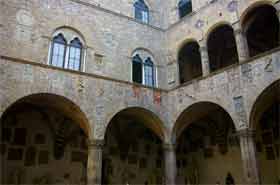
Florence contains numerous museums and art galleries where some of the world’s most important works of art are held. The city is one of the best preserved Renaissance centres of art and architecture in the world and has a high concentration of art, architecture and culture. In the ranking list of the 15 most visited Italian art museums, 2/3 are represented by Florentine museums. The Uffizi is one of these; one of the most famous and important art galleries in the world, it has a very large collection of international and Florentine art. The gallery is articulated in many halls, cataloged by schools and chronological order. Engendered by the Medici family’s artistic collections through the centuries, it houses works of art by various painters and artists. The Vasari Corridor is another gallery, built connecting the Palazzo Vecchio with the Pitti Palace passing by the Uffizi and over the Ponte Vecchio. The Galleria dell’ Accademia houses a Michelangelo collection, including the David. It has a collection of Russian icons and works by various artists and painters. Furthermore, other museums and galleries include the Bargello, which concentrates on sculpture works by artists including Donatello, Giambologna and Michelangelo; the Palazzo Pitti, containing part of the Medici family’s former private collection. In addition to the Medici collection, the palace’s galleries contain many Renaissance works, including several by Raphael and Titian, large collections of costumes, ceremonial carriages, silver, porcelain and a gallery of modern art dating from the 18th century. Adjoining the palace are the Boboli Gardens, elaborately landscaped and with numerous sculptures.
Religious Buildings
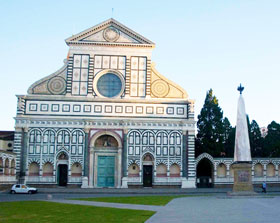
There are several different churches and religious buildings in Florence. The Cathedral is the Santa Maria del Fiore. It is the fourth largest church in Europe, its length being 153 metres (502 ft) and its height 116 metres (381 ft). The San Giovanni Baptistery is located in front of the Florence Cathedral, and it is decorated by numerous artists, notably by Lorenzo Ghiberti with the Gates of Paradise. Other churches in Florence include the Basilica of Santa Maria Novella, located in Santa Maria Novella square (near the Firenze Santa Maria Novella railway station) which contains works by Masaccio, Paolo Uccello, Filippino Lippi and Domenico Ghirlandaio; the Basilica of Santa Croce, the principal Franciscan church in the city, which is situated on the Piazza di Santa Croce, about 800 metres south east of the Duomo, and is the burial place of some of the most illustrious Italians, such as Michelangelo, Galileo, Machiavelli, Foscolo, Gentile, Rossini, and Marconi, thus it is known also as the Temple of the Italian Glories (Tempio dell’Itale Glorie); the Basilica of San Lorenzo, which is one of the largest churches in the city, situated at the centre of Florence’s main market district, and the burial place of all the principal members of the Medici family from Cosimo il Vecchio to Cosimo III; Santo Spirito, in the Oltrarno quarter, facing the square with the same name; Santissima Annunziata, a Roman Catholic basilica and the mother church of the Servite order; Ognissanti, which was founded by the lay order of the Umiliati, and is among the first examples of Baroque architecture built in the city; the Santa Maria del Carmine, in the Oltrarno district of Florence, which is the location of the Brancacci Chapel, housing outstanding Renaissance frescoes by Masaccio and Masolino da Panicale, later finished by Filippino Lippi; the Medici Chapel, in the San Lorenzo; as well as several others, including Santa Trinita, San Marco, Santa Felicita, Badia Fiorentina, San Gaetano, San Miniato al Monte, Florence Charterhouse, and Santa Maria del Carmine. The city additionally contains the Orthodox Russian church of Nativity, and the Great Synagogue of Florence, built in the 19th century.