
Location
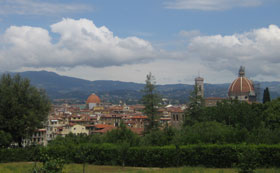
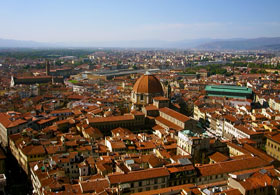
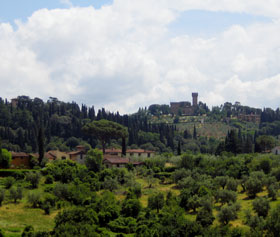
Florence lies in a basin among the Senese Clavey Hills, particularly the hills of Careggi, Fiesole, Settignano, Arcetri, Poggio Imperiale and Bellosguardo (Florence). The Arno river and three other minor rivers flow through it.
Climate
Florence has a borderline humid subtropical and Mediterranean climate. It has hot, humid summers with moderate rainfall and cool, damp winters. Surrounded by hills in a river valley, Florence can be hot and humid from June to August. As Florence lacks a prevailing wind, summer temperatures are higher than along the coast. Rainfall in summer is convectional, while relief rainfall dominates in the winter, with some snow. The highest officially recorded temperature was 42.6 °C (108.7 °F) on 26 July 1983 and the lowest was −23.2 °C (−9.8 °F) on 12 January 1985.
Cuisine
Florentine food grows out of a tradition of peasant eating rather than rarefied high cooking. The majority of dishes are based on meat. The whole animal was traditionally eaten; tripe, (trippa) and (lampredotto) were once regularly on the menu and still are sold at the food carts stationed throughout the city. Antipasti include crostini toscani, sliced bread rounds topped with a chicken liver-based pâté, and sliced meats (mainly prosciutto and salame, often served with melon when in season). The typically saltless Tuscan bread, obtained with natural levain frequently features in Florentine courses, especially in its soups, ribollita and pappa al pomodoro, or in the salad of bread and fresh vegetables called panzanella that is served in summer. The bistecca alla fiorentina is a large (the customary size should weigh around 1200 grams – “40 oz.”) – the “date” steak – T-bone steak of Chianina beef cooked over hot charcoal and served very rare with its more recently derived version, the tagliata, sliced rare beef served on a bed of arugula, often with slices of Parmesan cheese on top. Most of these courses are generally served with local olive oil, also a prime product enjoying a worldwide reputation.
abc