
Rome’s architecture over the centuries has greatly developed, especially from the Classical and Imperial Roman styles to modern Fascist architecture. Rome was for a period one of the world’s main epicentres of classical architecture, developing new forms such as the arch, the dome and the vault. The Romanesque style in the 11th, 12th and 13th centuries was also widely used in Roman architecture, and later the city became one of the main centres of Renaissance and Baroque architecture.
Ancient Rome
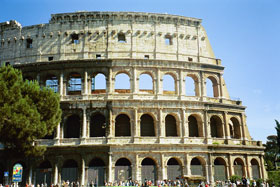
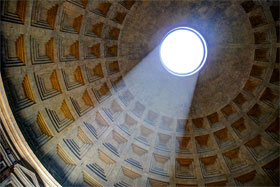
One of the symbols of Rome is the Colosseum (70–80 AD), the largest amphitheatre ever built in the Roman Empire. Originally capable of seating 60,000 spectators, it was used for gladiatorial combat. A list of important monuments and sites of ancient Rome includes the Roman Forum, the Domus Aurea, the Pantheon, Trajan’s Column, Trajan’s Market, the Catacombs, the Circus Maximus, the Baths of Caracalla, Castel Sant’Angelo, the Mausoleum of Augustus, the Ara Pacis, the Arch of Constantine, the Pyramid of Cestius, and the Bocca della Verità.
Medieval
Often overlooked, Rome’s medieval heritage is one of the largest in Italian cities. Basilicas dating from the Paleochristian age include Santa Maria Maggiore and San Paolo Fuori le Mura (the latter largely rebuilt in the 19th century), both housing precious 4th century AD mosaics. Later notable medieval mosaic and fresco art can be also found in the churches of Santa Maria in Trastevere, Santi Quattro Coronati, and Santa Prassede. Lay buildings include a number of towers, the largest being the Torre delle Milizie and the Torre dei Conti, both next the Roman Forum, and the huge staircase leading to the basilica of Santa Maria in Ara Coeli.
Renaissance and Baroque
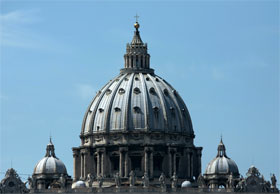
Rome was a major world centre of the Renaissance, second only to Florence, and was profoundly affected by the movement. Among others, a masterpiece of Renaissance architecture in Rome is the Piazza del Campidoglio by Michelangelo. During this period, the great aristocratic families of Rome used to build opulent dwellings as the Palazzo del Quirinale (now seat of the President of the Italian Republic), the Palazzo Venezia, the Palazzo Farnese, the Palazzo Barberini, the Palazzo Chigi (now seat of the Italian Prime Minister), the Palazzo Spada, the Palazzo della Cancelleria, and the Villa Farnesina.
Many of the famous city’s squares – some huge, majestic and often adorned with obelisks, some small and picturesque – got their present shape during the Renaissance and Baroque. The principal ones are Piazza Navona, Piazza di Spagna, Campo de’ Fiori, Piazza Venezia, Piazza Farnese, Piazza della Rotonda and Piazza della Minerva. One of the most emblematic examples of Baroque art is the Fontana di Trevi by Nicola Salvi. Other notable 17th-century baroque palaces are the Palazzo Madama, now the seat of the Italian Senate and the Palazzo Montecitorio, now the seat of the Chamber of Deputies of Italy.
Neoclassicism
In 1870, Rome became the capital city of the new Kingdom of Italy. During this time, neoclassicism, a building style influenced by the architecture of antiquity, became a predominant influence in Roman architecture. During this period, many great palaces in neoclassical styles were built to host ministries, embassies, and other governing agencies. One of the best-known symbols of Roman neoclassicism is the Monument of Vittorio Emanuele II or “Altar of the Fatherland”, where the Grave of the Unknown Soldier, that represents the 650,000 Italians that fell in World War I, is located.
Fascist Architecture
The Fascist regime that ruled in Italy between 1922 and 1943 developed an architectural style that was characterised by its links with ancient Roman architecture. The most important Fascist site in Rome is the E.U.R. district, designed in 1938 by Marcello Piacentini. It was originally conceived for the 1942 world exhibition, and was called “E.42” (“Esposizione 42”). The world exhibition, however, never took place because Italy entered the Second World War in 1940. The most representative building of the Fascist style at E.U.R. is the Palazzo della Civiltà Italiana (1938–1943), the iconic design of which has been labelled the cubic of Square Colosseum. After World War II, the Roman authorities found that they already had the seed of an off-centre business district of the type that other capitals were still planning (London Docklands and La Defense in Paris). Also the Palazzo della Farnesina, the current seat of the Italian Ministry of Foreign Affairs, was designed in 1935 in pure Fascist style.
abc
abc