
Rome has an urban transport network which consists of buses, trams, rapid transit lines, light rail lines and suburban railways.
Atac (Agenzia del Trasporto Autoferrotranviario del Comune di Roma, Agency for rail and road transport of the city of Rome) is the municipally-owned public transport agency which manages public transport in the city.
Road Travel
Automobile
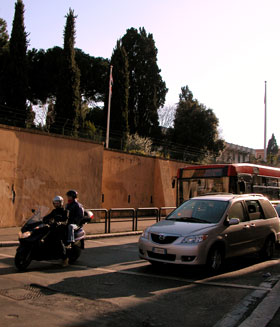
Traffic congestion in Rome is notorious. This issue is caused mainly by the undersized public transport network and the extremely low cars per capita ratio in the city. In fact, not only Italy has a very low ratio of cars per capita, but Rome has also one of the highest number of cars of any city in the country.
Motor Traffic Limited Zone (ZTL)
Chronic congestion caused by cars led to the partial banning of motor traffic from the central part of the city during workdays, from 6 am to 6 pm. This area is called Zona a Traffico Limitato (ZTL), motor traffic limited zone. Heavy traffic due to night-life crowds during weekends led in recent years to the creation of other ZTLs in the Trastevere and S. Lorenzo districts during the night, and to experimentation with a new night ZTL also in the city centre (plans are underway to create a night ZTL in the Testaccio district as well). In spite of all these measures, traffic in Rome remains an unsolved problem.
Buses
Rome has a comprehensive bus network, including two trollybus routes (with additional trolleybus lines under construction). The Metrebus integrated fare system allows holders of tickets and integrated passes to travel on all companies vehicles, within the validity time of the ticket purchased.
Rail Travel
Rome Metro
Rome Metro is the rapid transit system serving the city with two underground lines.The total length of the network is 4 1.5 km (25.8 mi) with 52 stations. There are two lines A, B and a diramation called B1, they intersect at Roma Termini station.
A third line, line C, is under construction. It will serve 30 stations over a distance of 25.5 km (15.8 mi). It will partly replace the existing tram line, Termini-Pantano and it will feature full automated, driverless trains.
A fourth line, line D, is under development. It will have 22 stations over a distance of 20 km (12 mi).
Trams and Commuter Rail
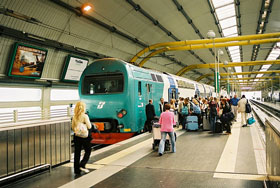
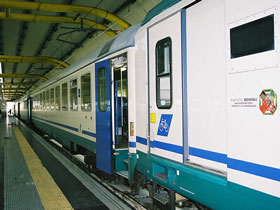
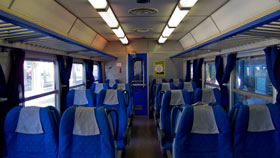
Rome overground rail transport comprises the tramway network, suburban and urban lines in and around the city of Rome, plus an “express line” to Fiumicino Airport. Whereas most FS-Regionale lines (Regional State Railways) provide a largely suburban service with more than twenty stations scattered throughout the city, a metro-like service is provided by the Roma-Lido (starting at Ostiense station) and Roma-Nord (starting at Flaminio station) rail lines, but with lower frequencies than Metro lines, as the Rome-Giardinetti light rail line. There is also the Lazio regional railway. a commuter rail system with seven lines which link the hinterland of the Rome Metropolitan Area. One of these lines serves the second airport of the city, Ciampino.
Railways
The main railway station serving the city, Roma Termini, is the busiest station in Italy and one of the largest in Europe. The second largest station in the city is Roma Tiburtina, which is being redeveloped for high-speed rail service. Other notable stations include Roma Ostiense, Roma Trastevere, Roma Tuscolana, Roma San Pietro, Roma Nomentana and Roma Casilina.
Airports
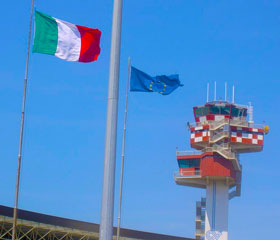
Rome is served by three civil airports. The intercontinental Leonardo Da Vinci Airport is Italy’s largest airport both for national and international traffic and is one of the busiest in Europe. It is more commonly known as Fiumicino, as it is located within the territory of the nearby comune of Fiumicino, in the south-west of Rome. The older Rome Ciampino Airport is a joint civilian and military airport. These main two airports are owned and managed by Aeroporti di Roma.
The third airport serving the city, the Aeroporto dell’Urbe, is a small, low-traffic airport located about 6 km (3.7 mi) north of the city centre, which handles most helicopter and private flights.
A fourth airport in the eastern part of the city, the Aeroporto di Centocelle (dedicated to Francesco Baracca), is no longer open to civil flights; it hosts the Comando di Squadra Aerea (which coordinates the activities of the Aeronautica Militare) and the Comando Operativo di Vertice Interforze (which coordinates all Italian military activities), although large parts of the airport are being redeveloped as a public park.
abc
abc